•Disclosure Dispatch• Everything that I could share

Japanezation

Exploration

Mad Friendship

Monday, January 9, 2017


Dalam pembelajaran bahasa,  setelah menguasai setidaknya Level Intermediet. Kita akan mempelajari perihal surat-menyurat. Begitu juga dalam bahasa jepang, yang setidaknya harus menguasai JLPT N3 untuk dapat surat-menyurat.
Begitulah pernyataan pada masa pra-gadgetfever. Ya, saat ini tidak perlu begitu, hanya dengan JLPT N4~N5 bahkan berbekal 25 Bab Minna no Nihongo sekalipun asalkan berikut persenjataan smartphone dan browsing, cukuplah sudah untuk berangkat ke medan surat bahasa jepang.
Lepas dari sekedar meletakan ungkapan dalam kertas kemudian memasukan kedalam amplop/e-mail, seperti apakah bentuk surat-menyurat dalam bahasa jepang?
Berikut pembahasan mengenai penulisan surat dalam bahasa jepang.

1.      ATURAN
Secara sederhana surat dalam bahasa jepang terbagi dalam 2 jenis, yaitu :
·  Formal 改まった手紙 (Aratamatta tegami)
Pada surat resmi ini berupa surat yang ditujukan kepada lembaga resmi, atau personal yang dihormati. Seperti atasan, guru, orang yang tidak dekat, surat bisnis, pengumuman dll. 
·  Informal 親しい人への手紙 (Shitashii hito e tegami)
Surat ini ditujukan kepada orang yang dekat dan tidak terikat aturan yang baku. Contoh : teman, keluarga, junior dll.


2.      FORMAT
Dalam format surat bahasa jepang, Ada dua jenis surat, yaitu
o  Penulisan Vertikal 縦書き (Tategaki)
Tipe ini merupakan standar penulisan surat dalam bahasa jepang dan tidak boleh salah.
Berikut ini adalah hal-hal yang harus diperhatikan dalam penulisan vertikal.
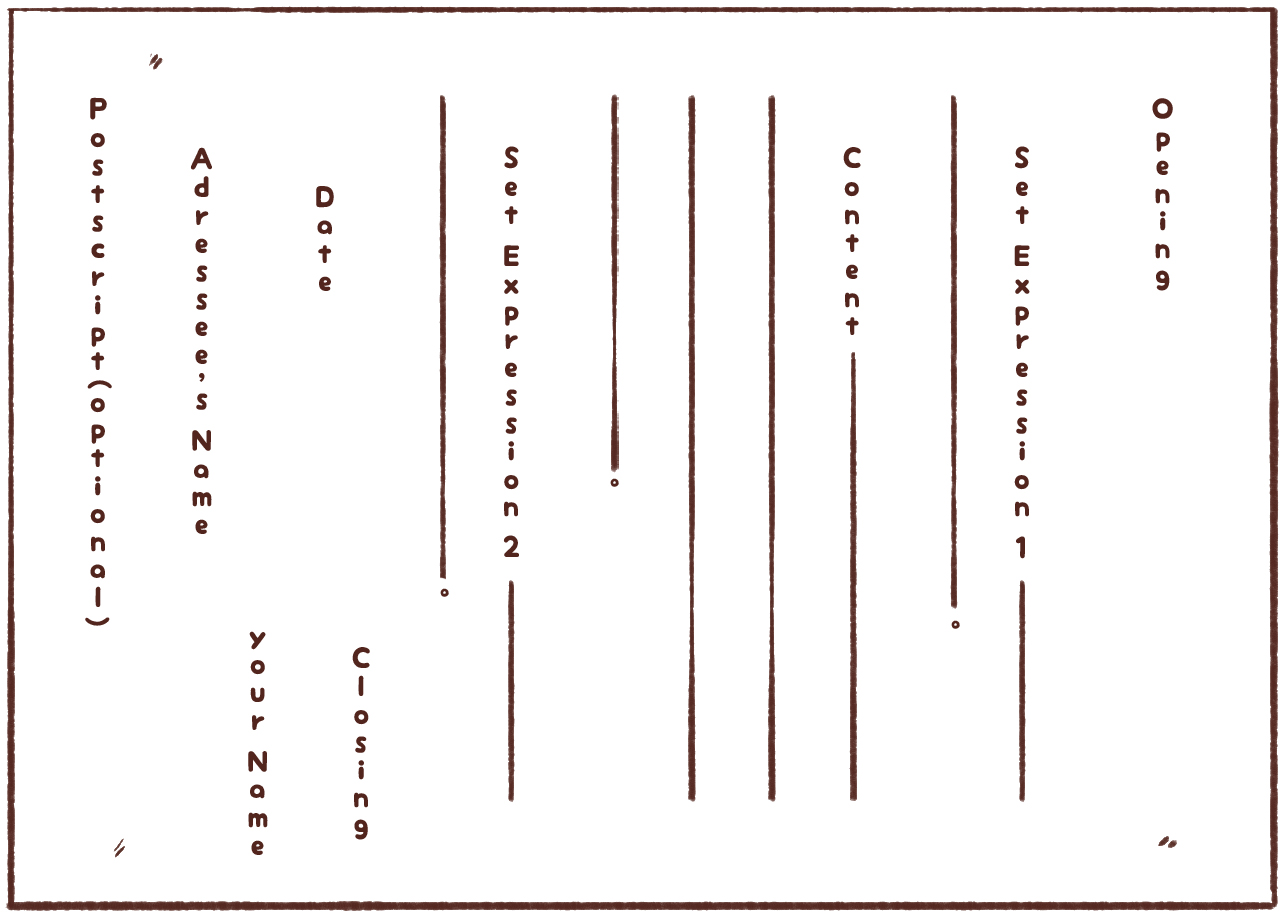


Opening: Letakan salam pembuka pada bagian ini, namun perhatikan pasangan salam penutupnya. Contoh「拝啓」「謹啓」「前略」「拝復」「復啓」「敬復」、結語に「敬具」「拝答」「敬答」dan untuk surat balasan dapat menggunakan「再啓」「再呈」「追啓」.
Set Expression #1: Dalam surat jepang selalu meletakan ekspresi mengenai keadaan (cuaca, situasi dll.) yang digunakan sebagai pembuka isi surat.
Content: Isi surat.
Set Expression #2: Satu lagi ungkapan tambahan dalam harapan baik atau tujuan baik. Seperti harapan selalu sehat dsj.
Your Name: Dalam penulisan nama pengirim akan lebih baik apabila menggunakan pena dengan penulisan vertikal juga berikut cap nama (formalitas jepang).
Adressse's Name: Pada akhir surat di sematkan tujuan surat (bila surat instansi berikut instansi dan jabatan) disertakan nama penghormatannya: 「様. Penulisannya di format agar nama tujuan surat terletak diatas nama pengirim.

o  Penulisan Horizontal 横書き (Yokogaki)
Penulisan horizontal adalah penulisan yang sederhana dan mudah, akan tetapi terkesan datar dan dingin yang justru dapat terkesan tidak sopan bergantung pada tujuan suratnya.
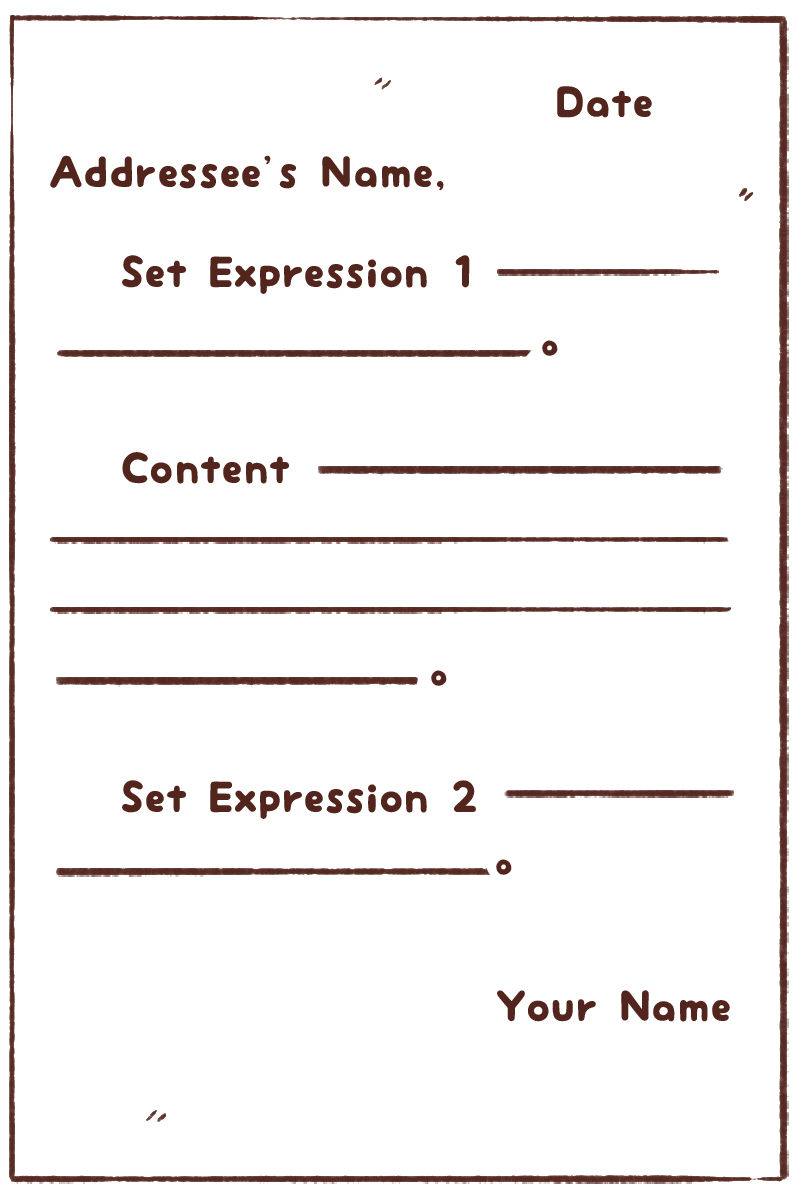


Date: Penulisan tanggal pada pojok kanan atas, dengan tulisan penanggalan jepang sebagai contoh : 2016年12月25日.
Addressee's Name: Tulisan nama personal tujuan surat, disertakan nama penghormatannya: 「様
Set Expression #1: Ekspresi awal.
Content: Isi surat.
Set Expression #2: Ekspresi akhir.
Your Name: Nama pengirim


Begitulah format surat dalam bahasa jepang.

Surat-menyurat di negeri produsen animasi terbesar ini ditemukan bahwa sudah terjadi sejak tahun 3 Maret Meiji-4 (1871) dengan ditemukannya  surat terkuno di Stasiun Minakuchi  Perfektur Shiga yang kemungkinan dikirim dari Tokyo pada 1 Maret.


Surat tertua di Jepang bernilai 30jt yen atau 3 milyar rupiah.


Berikut ini juga salah satu surat kuno yang ditulis oleh Kyoka Izumi (1873-1939) pada bulan Januari Meiji-35 (1902) Atami, ditujukan untuk Mugihito Hoshino (1877-1965). Isinya berupa catatan harian penulis atau mungkin laporan kegiatan.

              Izumi ditujukan kepada Hoshino (1902)


Wednesday, June 8, 2016

Memasuki Perguruan Tinggi merupakan salah satu option bagi anda yang menyelesaikan SMA atau bahkan SMK. Beragam pilihan Universitas/Institut Negeri maupun Swasta pun tidak luput menjadi pilihan.
Apabila anda tahu, juga tidak menjadi hal yang sulit untuk memasuki Perguruan Tinggi di luar negeri.
Negeri Sakura salah satunya yang merupakan pilihan terbaik bagi Mahasiswa Internasional. 

Berdasarkan Simposium Internasional : Perspective of Student Financial Assistance Policies di TIEC, Tokyo, Odaiba 9 Maret 2015 lalu, setiap perwakilan Negara mempresentasikan research masing-masing Negara mengenai Financial Records mahasiswa di Negaranya.  Yakni USA, UK, Australia, China dan Japan sendiri.
Dan hasilnya Jepang memiliki jumlah Tuition Fee untuk mahasiswa International hampir dibawah setengah Tuition Fee,diantara negara-negara maju lainnya, terutama Universitas Nasional Jepang (Tokyo University, Kyoto University, etc..). Event ini diselenggarakan oleh JASSO yayasan pendidikan di Jepang yang juga mengeluarkan scholarship untuk International students.
S1 / Bachelor Degree / Undergraduate
Dalam memasuki kuliah S1 dI Jepang, padan nya anda harus memiliki kemampuan Bahasa Jepang minimal level 2 (N2). Untuk beberapa perguruan tinggi mungkin memang ada yang menggunakan kelas Bahasa Inggris namun biasanya cenderung lebih mahal.
Kalaupun memutuskan untuk mengambil kelas bahasa inggris lebih baik meningkatkan kemampuan Bahasa Jepang yang nantinya akan digunakan sehari-hari.
Proses pendaftaran / apply ke perguruan tinggi Jepang dapat dilihat pada gambar berikut.

Monbukagakusho (Government Full Fund Scholarship)
Beasiswa penuh yang diberikan oleh pemerintah Jepang yang diadakan setahun sekali, untuk program S1, D3, dan D2. Sesuai yang akan didapatkan, beasiswa ini memiliki persaingan yang ketat dari seluruh Indonesia. Informasi pendaftaran Monbukagakusho sebagai berikut.


EJU (Examination for Japanese University)
Sebagai ujian kemampuan akademis untuk International Student yang akan mendaftar ke perguruan tinggi di Jepang. Diadakan setahun dua kali pada bulan Juli dan Oktober. Apabila memiliki skor terbaik pada EJU ini, bisa mendapatkan beasiswa dari JASSO (Japan Student Services Organization).
​​
ABP (Asia Bridge Program) Shizuoka University
Salah satu beasiswa yang menarik untuk mahasiswa international dengan taraf perguruan tinggi ternama di Jepang. Beasiswa Shizuoka University ini mengadakan seleksi setahun sekali melalui pendaftaran online dengan ujian seleksi berikut interview dilakukan di Universitas Indonesia (Jakarta).
Japanese Language School
Sebagai syarat masuk universitas agar mahasiswa berkemampuan Bahasa Jepang level 2 sampai level 1 adalah dengan mengikuti kursus Sekolah Bahasa di Jepang. Sekolah Bahasa bukan hanya sekedar pengajaran Bahasa Jepang saja, biasanya berikut kelas untuk membantu ujian EJU atau ujian masuk universitas yang di inginkan. Yang mana setiap universitas biasanya memiliki rekomendasi Sekolah Bahasanya, agar mempermudah dalam memasuki universitas yang diinginkan.
Sekolah bahasa mungkin anda kira sedikit mahal dibandingkan les LPK di Indonesia, namun selama anda bersekolah diperbolehkan untuk kerja sampilan / part-time (arubaito). Yang mana hasilnya akan cukup menutupi biaya sekolah dan bahkan untuk membantu biaya pendaftaran universitas nanti.
Cara ini menjadi efektif bagi yang memiliki kemampuan akademis standar dan kemampuan ekonomI standar.
Dan selama bersekolahpun  anda memiliki kesempatan untuk beradaptasi dengan kehidupan di Jepang, sehingga membantu untuk masa berkuliah nanti.​


Sekian kilasan mengenai mandat kuliah di Jepang, untuk informasi lainnya silahkan klik pada link berikut http://www.jasso.or.id/
 
Me in International Symposium, TIEC, Tokyo, Japan March 9th 2015


Saturday, November 21, 2015

After a month living in Narita (成田), I moved to Funabashi city (船橋) in prefecture Chiba (千葉県). Not so many different but industry area's nearby, lived in my own room, closer to the capital city, closer to convenient store & supermarket, and even closer to Tokyo Disneyland. *well too many differences 😆.
You find feeling ok with nothing different argument because it's still in the developed country. Which is where ever you are you still impressed by their infrastructure and technology compare to my homeland.
There is nothing left behind, they don't have a rough street or unsupplied electricity areas.*


When I came for the first time to my civilization, what do you expect? there is no English available. Even I've been told about that before, I didn't even Imagine that was the pure truth. You really need to learn Japanese to survive there [try to read multilingual]. And as long as I lived there, there was also a Japanese teacher (sensei,先生)** taking care about Living education in Japan for me.

I came to Funabashi with my chancellor teacher , and yeah the company was welcoming me, even there was a welcoming party at night. Very kind behavior and respect proving the eastern countries culture does exist, cuz I felt their culture similar to mine. As the Sonkeigo (尊敬語) which is just the same as Kromo Inggil (Javanese), which is the exclusive language to use for the older and respectively.
Not long after my arrival in Funabashi, there was Japanese Summer Festival (natsu matsuri, 夏祭り) around the town for welcoming the summer.
Japanese dance n music parade, ice grill, takoyaki stands, yakisoba, even there was a stand of mochi's making.
I am really excited in these moments, for me it means Funabashi city welcoming me to fulfill my misery and delighting story. The city of my civilization in Japan.


2012 Funabashi Natsu Matsuuri,  Me and my coworker


*   My friends was asking these to the Governor when he came to our place welcoming us in Narita, that's how I know those.
** Sensei (先生) is the words for many respected people and who know better about something, like Teacher, Doctor, etc.

Wednesday, November 18, 2015

FIRST TIME

House fields in Doraemon's anime, wooden houses, flip phones, bikers and pedestrian everywhere, amazing public transportation, clean air, healthy foods, all of that would just welcoming as your first stepping feet in Japan.
Because as top 5 the most peaceful country in the world, developed by high technology and healthy living environment are the way of welcoming to anyone.
Recorded as the higher old age population proving Japan is comfort enough made living a long life.

At first I was living in Narita City for living adaptation training in Japan / Nihon Seikatsu Kyouiku (日本生活教育). I lived in traditional wooden house and far away from the city, so what do u see is the crowd of trees, hills, ricefields, farms, temples, well traditional things. Somehow we got fresh while come to places like that, so it was a great time in the beginning of summer season.

And yes, globalization era is the moneyzation which is all about money.
So it also my first time having and using Japanese Money = Yen ¥ 円.
Japanese rice (tinier texture than south east asian) price was start from ¥ 1,000/5kg, fresh vegetables around ¥100/pack, soft drink are about ¥100/can.
The Convinience stores is miles away from house, nearby was the elementary school also as the evacuation place, and there was a really old age look like temple made from wood, and there was farm fields that in the summer we being asked to help harvesting and we would got some of watermelon or vegetables.
Right the next house there was a woman english teacher that yelling all the day if there is any disturbance and noisy as long we living there. She always coming knock the door appears followed by her cats that seems really loyal to her. Sometimes she even yelling in english, between she was really upset (for the noises coming from our house) or try to proofing to foreigner I understand English well.
Bus is about 2 hours once, sometimes more. You should just have your own transportation if you planning to living there.
And in the upper hills there is traditional houses in one block made from wood.
Narita as the semi traditional city, and my very first city in Japan.


Temple Narita-san, Narita, Chiba (lumia 1020)

The street heading to Narita-san


Friday, July 17, 2015


Paths and ways of your life is an unexpected journeys, or maybe it is an expected as you wish. However, life is a little bumpy Korra said (in avatar legend of Korra). Because it is for me.
I was live in tragic economy and graduated with not a real super score in SMKN 4 Bandung one of Vocational Highschool in Bandung city.
But I was be able to going overseas.
Japan is the country that I never even imagine to step my feet and breathing on that land.
Of course I quite familiar with their Anime, J-Pop, and their technology. Thanks for my  sister for that. But really I didn't even plan my life going to Japan before.
Not after I went to BLKLN (Indonesian Government Working Overseas Center) and found there is a way for vocational highschoolers that willing to working overseas could join JITCO (Japan International Training Cooperation Organization)`s program, known as kenshuusei (研修生) / jisshusei (実習生) / trainee.
JITCO is helping Developing Country to learning Technology and Japanese Culture in Japan as one of Developed Country.

My age wasn't enough yet to attend IMM JAPAN that was require 20 year old to join (in 2011).
This program is from the official Indonesian government cooperating with Japanese government (G2G). So they a little more selective, because the attendees would represent Indonesian Government as well.
After I gathering more information, there is plenty Agency helping to Jisshusei Program with variant programs. One that I interested is program from JIAEC that accepting attendees from 18 year old.
JIAEC is helping to attend JITCO's program from Japanese Companies that already have branch or representative office in Indonesia, or we can call company to company (C2C).

I applied on July 2011 when I was just graduated from Vocational High School 4 Bandung (SMKN 4 BANDUNG) and 17 year old. Then I was following interview 2 times (in Japanese), the 1st time I was completely strange with Japanese Language / Nihongo (日本語) so it was not satisfying interview yet.
After that I started Japanese Language training for Jisshusei in November, then got interview with Shibaura Shearing Indonesia (SSI) and accepted to attending Jisshusei in Shibaura Shearing Co. Ltd (芝浦シヤリング株式会社) in Funabashi city Office for three years.
I land in Cherry Blossom's Country in 18th June 2012 and my journeys in Japan started to begin.


For other information you can read in the website Career in Japan (Bahasa Indonesia)


   "ANCIENT STUDENT", by Lumia 1020, Edo Wonderland, Nikko


  "HELLO JAPAN" , Sakura Festival in Ebikawa, Funabashi


Popular Posts